
The Sandie Peggie Case | Dr Webberley Responds 🏥
Can a transgender woman use the female changing room at work?
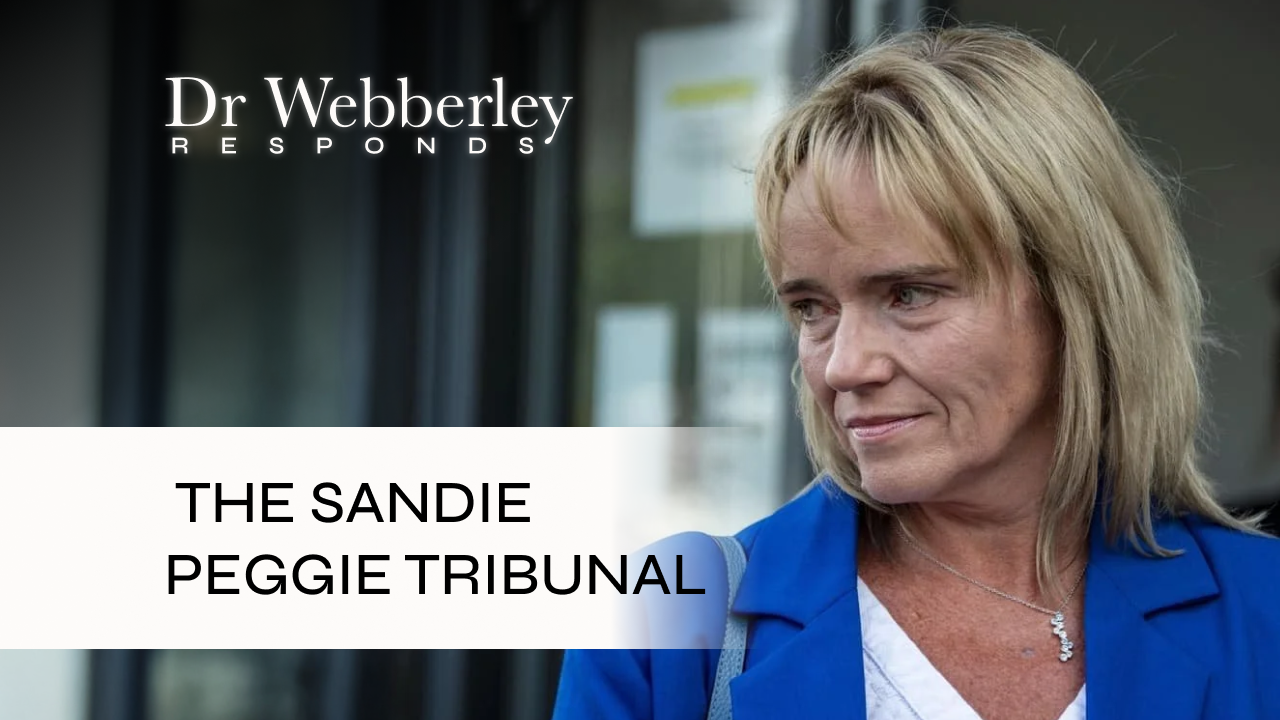
I’ve been following this tribunal closely since the very start. It’s importance cannot be overstated, as a landmark court case that will be cited for years to come. It provides much-needed clarity following the For Women Scotland Supreme Court decision, which has been widely misrepresented as meaning trans women cannot use female-only spaces.
Sandie Peggie, aged 50, is a nurse with 30 years’ experience. Dr Beth Upton is a doctor, aged 28. Both worked in the Emergency Department at Victoria Hospital, Kirkcaldy, and used the same changing room to get changed for work.
Sandie holds what are often called “gender-critical beliefs”. She believes that those who are biologically male cannot be female, and that Dr Upton is a male person.
Dr Upton is a transgender woman who has been living as female since 2022. Before starting work in the department, she checked with her manager that it was acceptable for her to use the female changing room and was told that she could. She had also used the female changing room in her previous job without issue.
Sandie’s case was that it was against the law for a transgender woman to use a female changing room and that she had been treated badly when she raised her concerns. The Employment Tribunal heard the case in late 2025.
The case was hotly debated online. Two women, both working for the NHS, both getting changed for work in the same changing room. What ever could be the problem?

The tribunal
Timeline of events
August 2023: Beth was in the changing room putting on her shoes. Sandie came in, saw Beth, and left again, going back in only when Beth had gone. Beth saw what Sandie had done and was saddened by it.
Sandie then texted a colleague: “The trans doctor was in the middle of getting changed when I went in this morning.” The colleague replied “you have made my night” with laughing emojis. Sandie continued: “OMG IT WAS NOT FUNNY. I just looked at him and come back out lol. Don’t think it’s right though. Don’t mind him her but I would have been raging if he had walked in on me half naked.”
August to October 2023: Sandie raised the issue with management several times. She was told that a trans woman could use the female changing room, and that if Sandie was uncomfortable, she could use a different space to get changed. Management sought advice from the Equality and Human Rights Lead Officer, who confirmed the position.
October 2023: Sandie was getting changed and was in her bra and trousers when Beth entered the changing room. Sandie put her top back on and waited outside until Beth had gone.
November 2023: Dr Upton was with a patient when Sandie came into the room. Beth asked her to do some observations on the patient, but Sandie just left the room.
Christmas Eve 2023: Beth and two others were in the changing room when Sandie came in to change. Sandie told Beth she didn’t think it was right that she was in there and that lots of other people felt the same way. She then asked Beth what her chromosomes were. Beth said she was sorry Sandie felt that way and advised her to raise the issue formally rather than in person. Sandie repeated that lots of people were talking about it and felt intimidated, that Beth was not a woman, and that Beth’s presence in the changing room was akin to a convicted rapist being housed in a women’s prison after transitioning. Beth was very distressed, upset, tearful and shaken. She found her supervisor and began to report the matter formally.
28 December 2023: Beth had asked another doctor to get changed at the same time so she wouldn’t be alone with Sandie. The other doctor’s train was late. Beth went into the changing room, saw Sandie was there, and hurriedly left.
29 December 2023: Dr Searle, Beth’s supervisor, recorded the incident formally as a “verbal assault” with the motivating factor listed as “gender reassignment”.
30 December 2023: Sandie was placed on special leave. Her response was that “if they did not want her to come to work and pay her for sitting at home that was fine with her.” She texted a colleague: “I’ll lose the argument though. Everyone sticks up for the minority. Wouldn’t be so bad but I’ve been feckin pleasant with her and didn’t even bully. I was shaking like a leaf. I’m mad now though. My mum said she would make her into a woman!!!”
January 2024: Sandie was formally suspended. In text messages, she described Beth as “it” and a “weirdo”, and made reference to Beth having a shadow (stubble) and a “pathetic voice”.
March 2024: Sandie was offered alternative work but declined. She requested that management not permit “those she regarded as men” to use the female changing room.
July 2025: The NHS disciplinary allegations against Sandie were dropped due to inconclusive or insufficient evidence.
The verdict
The Employment Tribunal dismissed all of Sandie’s allegations against the Health Board regarding discrimination and victimisation. It also dismissed her claim against Dr Upton.
However, the Tribunal found that the Health Board had mishandled some aspects of how it dealt with Sandie, and this did amount to harassment under the Equality Act. Specifically:
- The Board said they would sort out the rota so Sandie and Beth were not working at the same time, but they could have temporarily asked Beth not to use the female changing room while the rotas were being changed.
- NHS Fife took too long to investigate Beth’s complaints about Sandie’s behaviour.
- NHS Fife raised concerns about Sandie’s nursing care within this case when it should have been dealt with separately.
- The Board told Sandie not to discuss the case when she should have been allowed to.
Answers - truthful ones
Can a trans woman use the female changing room?
The tribunal was clear:
Yes, Dr Upton was allowed to use the female changing room. The Health Board gave her permission to do so, and this was perfectly OK.
A “female only” sign does not mean “cis females only”. The Tribunal stated: “We did not consider that a sign on a door created any rule under the 2010 Act or otherwise that only biological women could use it.”
The For Women Scotland Supreme Court case did not change this. That case determined that “biological sex” means sex assigned at birth for the purposes of the Equality Act. It did not determine that trans women cannot use female-only spaces. The Tribunal concluded: “that decision did not result in it being inherently unlawful for a trans female, who is biologically male under the Act, to be given permission to use a female changing room at work.”
It is potentially lawful to permit a trans woman to use a female-only space, dependent on circumstances. Having the protected characteristic of gender reassignment does not automatically grant access, nor does it automatically exclude. It depends on a balancing exercise.
Who was right?
The Tribunal found Dr Upton to be “a credible and broadly reliable witness” who “answered all the questions in a calm and considered manner.”
Of Sandie, the Tribunal noted: “she gave evidence that in some particular respects we did not consider to be credible”, that “she was generally transphobic”, and that there were “internal inconsistencies in her evidence.” Initially Sandie claimed support from four staff members, but on recall the number increased to thirteen, which “was a very surprising increase, which was not explained.”
The Tribunal found that Sandie’s expert witness, Maya Forstater, “did not give candid answers to the question asked, but sought to answer it in a manner that supported her general position which is gender critical. It was very clear that she had a strong and partial view.” Her evidence was not considered.
The Tribunal also noted that Sandie’s husband had made social media posts that “would be regarded by many as highly objectionable at the least, with comments that appeared to be transphobic, Islamophobic, and with a more general racial element.”
Who was being fair? Beth, or Sandie?
The Tribunal found that Sandie’s comments to Beth on Christmas Eve “were impermissible manifestations of her belief and were in our view what amounted to an incident of harassment by the claimant of Beth related to the protected characteristic of gender reassignment.”
The Tribunal noted: “Dr Upton was entitled to view the actions of Sandie as being such harassment, or as a ‘hate incident’.”
On Sandie’s attempts to convert Beth to her viewpoint, the Tribunal observed: “Proselytizing can be defined as attempting to convert someone from one religion, belief, or opinion to another... In our view in essentials that is what Sandie sought to do.”
So, are ‘gender-critical’ beliefs legal?
The Tribunal confirmed that gender-critical beliefs are protected under the Equality Act. However: “a protected belief does not give carte blanche to say whatever the person holding those beliefs wishes.” The holder of such a belief “is subject to the same prohibitions on discrimination, victimisation and harassment under the Act as all others.”
On misgendering: “That does not mean, however, that those with gender-critical beliefs can indiscriminately and gratuitously refer to trans persons in terms other than they would wish. Such conduct could, depending on the circumstances, amount to harassment of, or discrimination against, a trans person.”
And are trans women dangerous?
The Tribunal considered this question because Sandie had compared Beth’s presence in the changing room to a male rapist being housed in a women’s prison. It concluded: “We considered that there is not a sufficient evidential basis on which to make any finding that [transgender women] are statistically or otherwise more likely to be guilty of the crimes specified than biological women, or a risk to biological women greater than those who are biological women.”
But “anyone could just say they’re a woman”.
The Tribunal was clear: “A passing whim or disingenuous comment does not confer the protected characteristic of gender reassignment.”
Key Points
This is an important case. It provides much-needed clarity following the For Women Scotland Supreme Court decision, which has been widely misrepresented as meaning trans women cannot use female-only spaces. That is not what it said, and this tribunal has confirmed it.
Trans women can lawfully use female-only spaces at work. It depends on the circumstances, and employers should conduct a proper assessment, but there is no blanket ban. These questions need to be considered when achieving the aim of providing a safe and dignified space for people to use:
- Is allowing trans women to use the female spaces acceptable?
- Is banning trans women from female spaces acceptable?
- Is making female spaces only available to biological women acceptable?
- Is making trans women use male or disabled spaces acceptable?
Having gender-critical beliefs does not give you the right to harass trans people. You can hold those beliefs. You can even express them. But you cannot use them as a weapon against a colleague.
Dr Upton did nothing wrong. She checked with her manager. She followed the rules. She was calm and professional throughout. And yet she was subjected to harassment that left her distressed, tearful, and afraid to be alone in the changing room with Sandie.
Sandie had options. There was a private space available. She could have used a different changing room. Instead, she chose to confront Beth, compare her to a rapist, and question her chromosomes in front of colleagues.
The Tribunal found that Sandie “was generally transphobic”. Her text messages calling Beth “it” and a “weirdo”, mocking her voice, and her mother’s comment about “making her into a woman” paint a clear picture.
What saddens me most is that this could have been avoided.
- If Sandie had taken her concerns to management formally rather than confronting Beth directly.
- If the Health Board had a clear policy in place (they still don’t, as of July 2025).
- If people could simply extend basic dignity to their colleagues.
I have no doubt that all humans have the right to live as themselves, to live authentically, and to live without being abused or hurt at work. Let’s work together to achieve this.
Over to You
What do you make of this ruling? Does it help clarify the position following For Women Scotland? And what should employers be doing to prevent situations like this arising in the first place?
I’d love to hear your thoughts. Please subscribe to share them in the comments below.
Coming next: What should employers do? A practical guide to risk assessments and policies for trans inclusion in the workplace, based on the guidance from this case.
This is part of a series examining cases, commentary and hearings concerning gender identity. If you have a case or article you’d like me to review, get in touch.


Comments ()