
Are puberty blockers reversible?
What do the experts say?

A question that has dominated debate and discussions about gender-affirming care for children and adolescents. I recently appeared on LBC radio and was able to explain my position on this, and where I sourced my information from. When we look at medical research and evidence, we need to look at the experts where possible.
Let’s examine the question of reversibility of puberty blockers, and whether if you stop them do they stop working and normal sex hormone production resumes?
Expertise
The American Academy of Pediatrics is comprised of 67,000 pediatricians committed to the optimal physical, mental, and social health and well-being for all infants, children, adolescents, and young adults.
They published a policy statement on Ensuring Comprehensive Care and Support for Transgender and Gender-Diverse Children and Adolescents.
The Endocrine Society publishes the The Journal of Clinical Endocrinology & Metabolism, the world’s leading peer-reviewed journal for the dissemination of original research as it relates to the clinical practice of endocrinology, diabetes, and metabolism. They have published an Endocrine Society Clinical Practice Guideline: The Endocrine Treatment of Gender-Dysphoric/Gender-Incongruent Persons.
The World Professional Association of Transgender Health is a non-profit, interdisciplinary professional and educational organization devoted to transgender health1. WPATH publishes the Standards of Care for the Health of Transgender and Gender Diverse People, evidence-based standards for safe and effective gender-affirming health care and represent the most expert, in-depth, and evidence-based and consensus-based guidelines internationally.2
Endocrine Society:
WPATH
American Academy of Pediatrics
Stages of Care for Youth
Three stages6
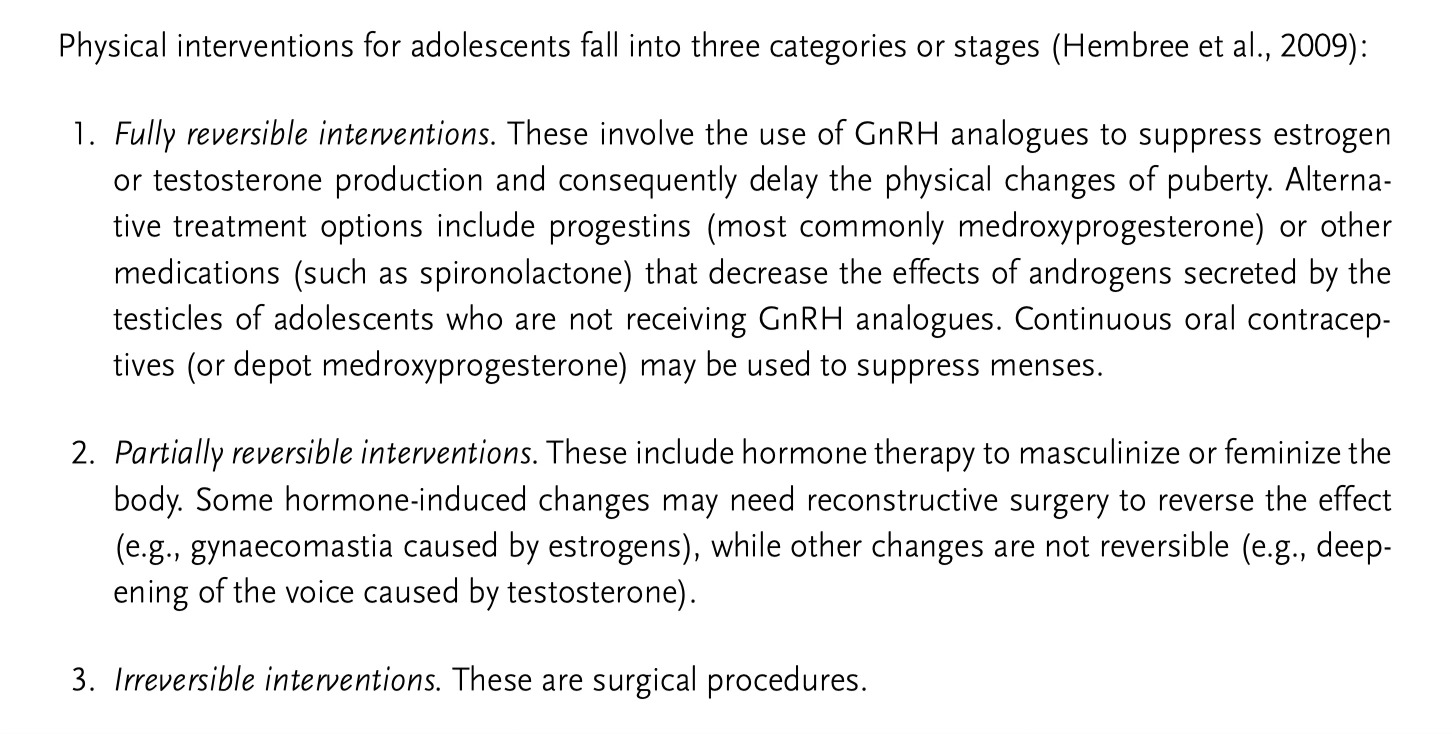
Puberty blockers are reversible
Across international paediatric and endocrine expertise, there is clear and consistent agreement that puberty blockers are medically reversible. Authoritative bodies including the American Academy of Pediatrics, the Endocrine Society, and WPATH all state that when puberty blockers are stopped, typical pubertal development driven by the body’s own sex hormones resumes. These medications, long used in paediatric care for decades, are intended to pause unwanted pubertal changes, reduce distress, and give young people time to explore their identity with appropriate clinical and psychosocial support. While public debate often clouds this issue, the medical consensus is clear: puberty blockers do not permanently halt puberty and are regarded by leading experts as a temporary, reversible intervention when appropriately prescribed and monitored.
Over to You
I’d love to hear your thoughts. Please subscribe to share them in the comments below.
This is part of a series examining cases, commentary and hearings concerning gender identity. If you have a case or article you’d like me to review, get in touch.
https://app.wpath.org/media/cms/Documents/SOC%20v8/SOC-8%20FAQs%20-%20WEBSITE2.pdf ↩
https://www.tandfonline.com/doi/pdf/10.1080/26895269.2022.2100644 ↩
https://publications.aap.org/pediatrics/article/142/4/e20182162/37381/Ensuring-Comprehensive-Care-and-Support-for ↩
https://www.tandfonline.com/doi/abs/10.1080/15532739.2011.700873 ↩


Comments ()